What is Voice Dialogue?
Voice Dialogue assumes that every personality consists of a very wide range of ‘I’s’ or sub-personalities. Each sub-personality has its own way of thinking, feeling, acting, and perceiving the world. For example, there is the perfectionist, the hedonist, the controller, the doer, the pleaser, the drammer.
A few of your Iken lead the way. These are primary sub-personalities. They largely determine your behavior and how you appear. In relation to trauma Were these primary subpersonalities ever created to protect you during overwhelming or prolonged unpleasant experiences? They are protective survival parts.
Protective parts
Depending on The impact of trauma specific and sometimes persistent protective traits will have evolved. For example, a strong inner critic, an addictive component, a component that adapts and/or sacrifices, and components that arise from disorganized attachment.
Beneath all those protective, primary parts lies vulnerability or hurt. Areas where you might prefer not to have contact with them, such as sadness, fear, loneliness, and shame.
So many more things
- The rejected parts, such as an assertive part or the good self-care practitioner.
- The underdeveloped parts that belong to the original child, such as their innocence, playfulness, and creativity.
Taking care of others
Through Voice Dialogue, you can develop the awareness of this. And learn to, without judgment, look at and listen to all your selves. In contact with those different selves, you discover what the underlying hurt is and learn to care for it, so that you can develop new response possibilities in your life.
How did Voice Dialogue come about?
Voice Dialogue It was developed in the 1970s by two American psychologists, Hal and Sidra Stone.
Voice Dialogue has its roots in Jungian thought, but it also incorporates elements of psychodrama, transactional analysis, Gestalt, psychosynthesis, client-centered therapy, and mindfulness.
What do Voice Dialogue sessions look like?
In a Voice Dialogue session, you can learn to look at your egos with a transcendent, non-judgmental eye. You literally give a ego a physical place by placing it on a chair. You discover when it emerged in your life, why it was necessary, and in what way it protects your vulnerability.
You gain recognition and can discover what needs you share. You can physically and energetically experience how a part within you works. The therapist guides you in exploring the parts, provides recognition for the pain, and helps to approach the parts without judgment and with compassion, facilitating the (inner) dialogue.
For which complaints can Voice Dialogue be used?
Voice Dialogue is a method that is used both in coaching and therapy. Nowadays, in the case of trauma, we are primarily concerned with the consequences of the event in your inner world. Survival parts are often triggered by situations and in relationships. If you find that you get stuck in yourself and keep repeating the same patterns, then Voice Dialogue is a method that can help you:
- To gain a clear view of your performance;
- To bring to light the underlying injury;
- To deal with it in a different, milder way.
What can Voice Dialogue bring you?
- You can gain more understanding of yourself;
- You can still pay attention to the injured parts;
- Mastery of regulating the dominance of the primary parts;
- Rejected or suppressed parts allow you to make them part of your personality again;
- The better you get to know all your selves, the more control you will be able to experience and the more conscious choices you will be able to make.
Where can I find a Voice Dialogue facilitator?
Voice Dialogue is a methodology, not a therapeutic approach. Professionals who use Voice Dialogue have already been trained as coaches or psychotherapists. Additionally, a facilitator has completed a Voice Dialogue training. To be able to apply Voice Dialogue effectively, in general and especially when working with trauma, specific knowledge and expertise are required.
Of International Voice Dialogue Agreement (IVDA) provides guidelines for you to be able to call yourself a Voice Dialogue Facilitator or Trainer.
Contacting the training institute
The best thing to do is to contact an educational institution where professionals are specifically trained in working with Voice Dialogue and trauma. At the educational institution, they know who is working psychotherapeutically with Voice Dialogue and trauma. On the website of the Voice Dialogue Institute You will find a map with the facilitators.
If you want to go looking for a Voice Dialogue Facilitator yourself, then take a good look at what the basic training of the facilitator is and how much Voice Dialogue training someone has had, specifically in working with trauma.
Where can I find more information about Voice Dialogue?
Reading tips
- I know my multiples – Judith Budde, Karin Brugman, Berry Collewijn
- Coming home in yourself – Hal and Sidra Stone
- Unmasking the inner critic – Hal and Sidra Stone
- Coaching with Voice Dialogue – Judith Budde and Karin Brugman
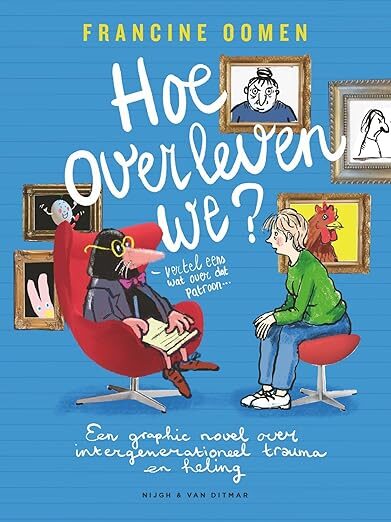
- How do we survive? – Francine Oomen
- Face to face with vulnerability – Marijke Leys
- Vulnerability as a compass – Marijke Leys
- In conversation with the Cheese Monster – Robert Stamboliev, Anita Roelands, Henriëtte Deckers
Viewing recommendations
Book recommendation
How do we survive? - Francine Oomen
A graphic novel about intergenerational trauma and healing
Read more?
Book recommendation
How do we survive? – Francine Oomen
A graphic novel about intergenerational trauma and healing
In collaboration with
Marijke Leys and Judith Budde
Marijke is the founder of the Voice Dialogue Institute,Trainer of Voice Dialogue experts, psychotherapist with expertise in parts work and author.
Judith is the director of the Voice Dialogue Academy, Voice Dialogue trainer, coach for leaders and professionals, and author.