What is writing therapy?
The goal of writing therapy is to process traumatic experiences, change negative thoughts about yourself, others, and the world, and learn new skills. You can share the written story with significant others; this is also called social sharing named.
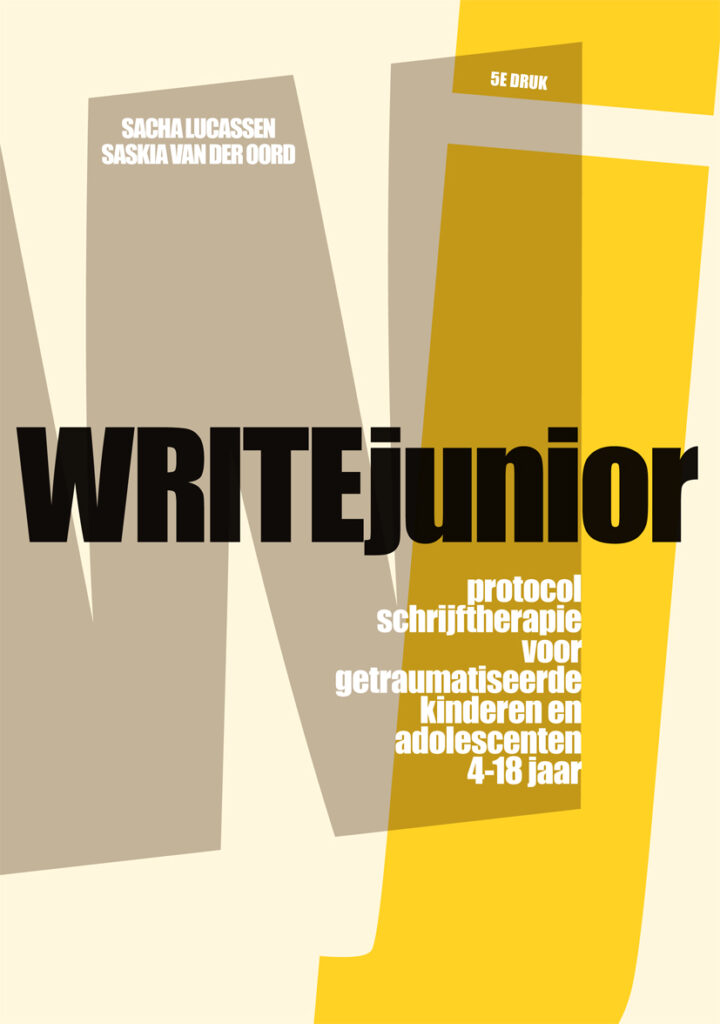
WRITEjunior
Writing therapy is also suitable for children and adolescents aged 4 to 18; that protocol is called WRITEjunior.
How did writing therapy originate?
Writing therapy for coping with traumatic experiences originates from an experimental study by Pennebaker and Beall (1986). In this study among students, writing about traumatic facts and emotions led to higher blood pressure and a negative mood immediately after writing, but appeared to lead to a decrease in the number of doctor visits in the half year following the writing.
The initiator of writing therapy in the Netherlands is Professor Alfred Lange, Professor of Clinical Psychology at the University of Amsterdam (1999). Lange is the founder of Interapy, currently an online mental healthcare institution that offers online writing therapy.
Sacha Lucassen (healthcare psychologist/behavioral therapist) and Saskia van de Oord (professor of psychology and educational sciences at KU Leuven) developed a writing therapy for youth, WRITEjunior, in 2008.
How does writing therapy work?
Interapy works as follows:
Writing assignments
In the first four writing assignments, you are going to describe what you have experienced. You will write in the first-person singular and the present tense, as if you are experiencing it right now. All details matter.
Advice letters
In the second phase of treatment, you will look at your own experiences from a different perspective. You write letters to an imaginary friend who has gone through the same thing. You advise your friend on how he or she can look at the situation differently.
Completion
In the final phase of treatment, you look back and focus on the future. You describe what you have experienced, how that has affected you, and how you want to deal with it now and in the future. Your letter serves as a symbolic conclusion to what you have experienced.
Your written story can be shared with significant others.
WRITEjunior works as follows:
An extensive intake with parents and the youth will be initiated, including the following components: a reconstruction of the traumatic event(s), an inventory of PTSD symptoms, ensuring safety, mobilization of the supportive network, and an explanation of PTSD and WRITEjunior.
Drawing comics
Next, it is decided how parents/guardians will be involved in the treatment. For children aged 4-7, a comic book is created together with the parents, featuring drawings by the children and written text by the therapist.
On the computer
With children and young people aged 8-18, work is done on the computer together with the therapist, and there is separate parental guidance, the content and intensity of which are tailored to individual needs. It is also possible to choose to write (parts of) the child's story together with the parents.
Four steps
First of all, a timeline is created as a guide for the story; this includes all traumatic events, as well as the fun events and things that are important for the context of the story.
Next, the writing of the story begins. During the writing process, exposure and cognitive restructuring take place with the help of the therapist. This means that the child expresses their feelings and thoughts, links them to the traumatic experiences, and views them in such a way that they are given a place in the history of the child's life story.
Next, it is described how he can adequately deal with his feelings and thoughts in the here and now.
Finally, the story is shared with parents (and perhaps significant others) and parents write a supportive comment.
In this way, the traumatic experiences can be processed and the child can regain a greater sense of control.
What symptoms can writing therapy help with?
For adults, children, and adolescents with a classification of post-traumatic stress disorder (PTSD) or trauma-related symptoms, with depression, and also with the loss of a loved one.
WRITEjunior can (with minor adjustments) also be given to:
- Children with mild intellectual disabilities
- Children with preverbal trauma
- Children with delayed PTSD symptoms
- Children of parents with mental health problems
- Revealing family secrets
Where can I take writing therapy?
Writing therapy at Interapy is a short-term and intensive online treatment with an average duration of 8 weeks.
WRITEjunior can be followed with various therapists and mental health institutions. The duration of the treatment depends on the severity of the PTSD symptoms, the number of traumatic events, and the available support in the environment.
Check whether the therapist has completed training as a behavioral therapist or psychologist/orthopedagogist. Or a higher vocational education (HBO) with sufficient CBT knowledge. For WRITEjunior, it is important that the therapist has completed postgraduate training in WRITEjunior.
Where can I find more information about writing therapy?
WRITEjunior writing therapy for traumatized adolescents and children.
WRITEjunior description Netherlands Youth Institute.
The website of Interapy
Description writing therapy on Wikipedia.
Reading tips
WRITEjunior, Writing therapy protocol for traumatized children and adolescents aged 4-18 years, Sacha Lucassen, Saskia van der Oord.
Opening Up By Writing It Down. How Expressive Writing Improves Health and Eases Emotional Pain, James W. Pennebaker.
Articles about WRITEjunior (via ‘practitioners’ and then ‘from the trade press’).
Viewing recommendations
The expressive writing method, James Pennebaker on YouTube.
WRITEjunior videos.
More information
WRITEjunior
Writing therapy for traumatized children and adolescents
In collaboration with
Dawn Bales
Clinical psychologist-psychotherapist and founder/former director at MBT Netherlands (MBT NL). Dawn, together with Peter Bleumer, founded the foundation in 2021 MBT Expertise established. She works at GGZ-Breburg as a manager of MBT innovation, researcher, and as a clinician in trauma-focused MBT. Dawn is co-author of the MBT quality handbook and holds a Ph.D. on the implementation of MBT in the Netherlands.