“We always predict the worst, that helps us survive.” With that sentence, professor of psychiatry and researcher Ruth Lanius opened her session Atlas of the Traumatized Brain: A Sensory Roadmap to Healing, during the Transform Trauma Oxford conference, which I am attending together with Frank.
An opening sentence that immediately reflects one of the most important insights about trauma and the brain: namely, that the traumatized brain does not predict what will happen in the future, but rather predicts what happened in the past. According to Lanius, trauma is therefore fundamentally about an ‘update problem’: the brain fails to process new, safe information, but continues to hold on to the old. The old that was dangerous, and which you must continue to fear.
A brain like a staircase
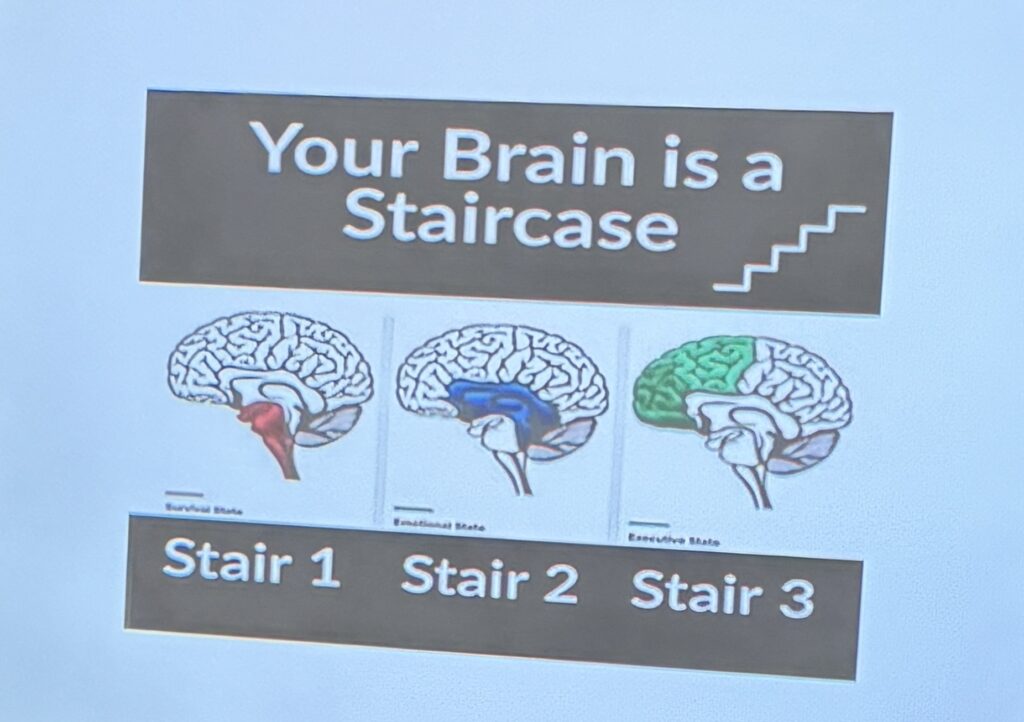
In her work, Lanius makes use of the triune brain model and explains that our brain is made up of three layers: the survival brain (or reptilian brain), the emotional brain (or mammalian brain), and the reflective brain (or thinking brain). You can view the layers like steps on a staircase, where trauma recovery is about connecting the brain regions at the bottom (bottom-up) as well as those from the top (top-down). Because only when the different layers work well together can traumatic experiences be processed and integrated.
The survival brain is the oldest part of the brain and is involved in automatic bodily functions. It reacts very quickly and unconsciously, experiences raw emotion, and activates instinctively survival reactions such as fight or freeze.
Finally, the reflective brain is important for a large number of skills that make us humans human, such as the capacity for (self-)reflection, emotion regulation, curiosity, the ability to see connections, and embodiment.
The impact of trauma on the brain
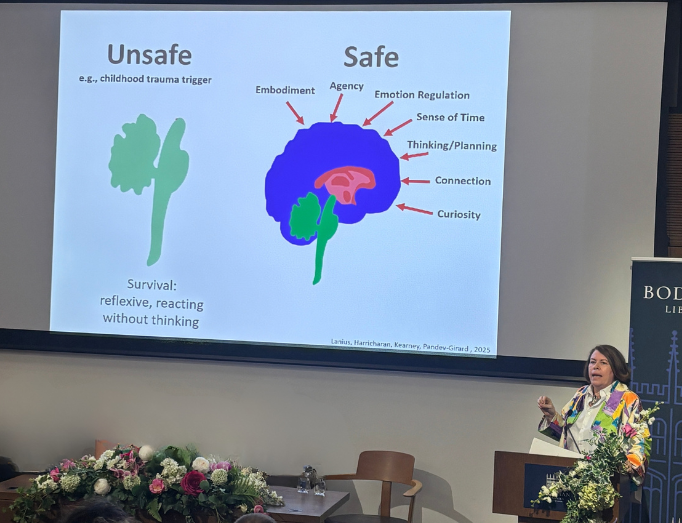
Lanius explains that with trauma, people often get stuck in that lower, unconscious layer of the survival brain, where the connection to the other brain areas is missing or too weak to truly let a new, (more) safe experience land. “With trauma, nothing is broken, there is no defect; at its core, it is primarily a brain connectivity problem” she says about this.
This partly explains why people who have experienced traumatic experiences can go through life without ever feeling truly fully connected or alive. Or without ever feeling truly safe, even though the objective danger may have long since passed. A brain that still perceives unsafety or is triggered is simply incapable of doing so.
According to Lanius, the famous statement ‘I think, therefore I am’ should actually be ‘I feel, therefore I am.’ Because it is the feelings and sensory stimuli from the survival brain that drive our thoughts, not the other way around.
The body and the senses as a compass for healing
Central to Lanius’ work is the role of the senses, including touch and the vestibular system, which is involved in balance and spatial orientation. She also devotes much attention to interoception, which is the ability to perceive internal signals such as your heartbeat or fatigue, and proprioception: the ability to perceive movement and the body's own position in space.
As a result of trauma, these sensory systems can become dysregulated. This can lead, for example, to dizziness, hypersensitivity to light or sound, issues with touch, or difficulty perceiving one's own bodily signals.“For many people with trauma, working directly with the body or interoception is too overwhelming. If it was ever too threatening to feel what you were feeling, then shutting off that feeling was very functional.”
How can you still carefully practice with the body and the awareness of body sensations? By working with the experience of rhythm and balance, such as rocking or gently swaying back and forth. “By feeling where you are in space and perceiving how your body moves, you naturally come closer to what is happening inside.”
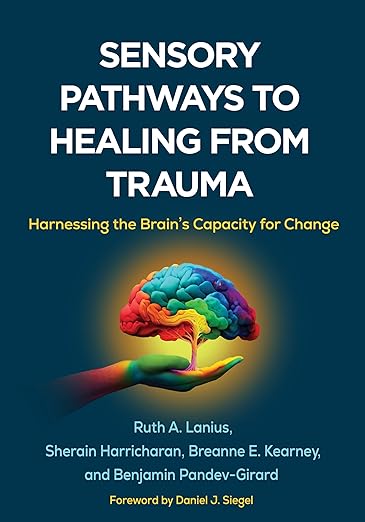
In her newest book ‘Sensory pathways to healing from trauma‘she elaborates on the various sensory systems, the impact of trauma, and how you can step by step use the wisdom of the body and the senses as a compass for healing. “We experience the world through our senses,” explains them, “that can perceive danger, but also signals of safety.”
The power and hope of neuroplasticity
Throughout her entire story, a positive and hopeful note consistently resonates, which she also explicitly concludes with at the end. The good news is that the brain, even after trauma, can continue to change and learn new things. This ability is called neuroplasticity, and it can be activated and stimulated by gaining new experiences. Learning to feel safe(r) in the world and in your body is not something you can approach through thinking or by talking about it; you have to feel and experience it.
Healing from trauma therefore requires repeated physical and sensory experiences of safety: small, measured, and manageable moments of touch, connection, rhythm, or movement that make the body and brain feel that now it is different than then.
Each of those experiences is, as it were, a new data point for the brain, which helps to slowly update and revise the old, threat-oriented prediction. That does not happen all at once, and not by completely overwriting the old story, but by gradually allowing a new story to emerge alongside it that, over time, can begin to weigh heavier than the past.
Lanius decides: “Recovery from trauma is often slow and gradual: the brain must literally relearn what safety is. And sometimes it learns this for the first time. Safe not as a thought or cognitive concept, but as an embodied experience. Thanks to neuroplasticity, that learning—no matter how traumatized someone is—is never entirely impossible. Therein lies the strength and hope.”
Reading tip
Sensory Pathways to Healing from Trauma
Harnessing the Brain’s Capacity for Change