What are survival responses?
A survival response is an automatic and instinctive reaction to an experienced threat or danger. Survival responses are sometimes also called stress responses or trauma responses. Even before you can think about it, your body and brain have already reacted and your stress system at full speed. A great deal of energy is then released, making you much stronger or faster than usual, for example.
Depending on factors including the situation, your capabilities (can you actually get away, or not?) and previous experiences, your system ‘chooses’ a survival response. One time that might be flight, and another time freeze.
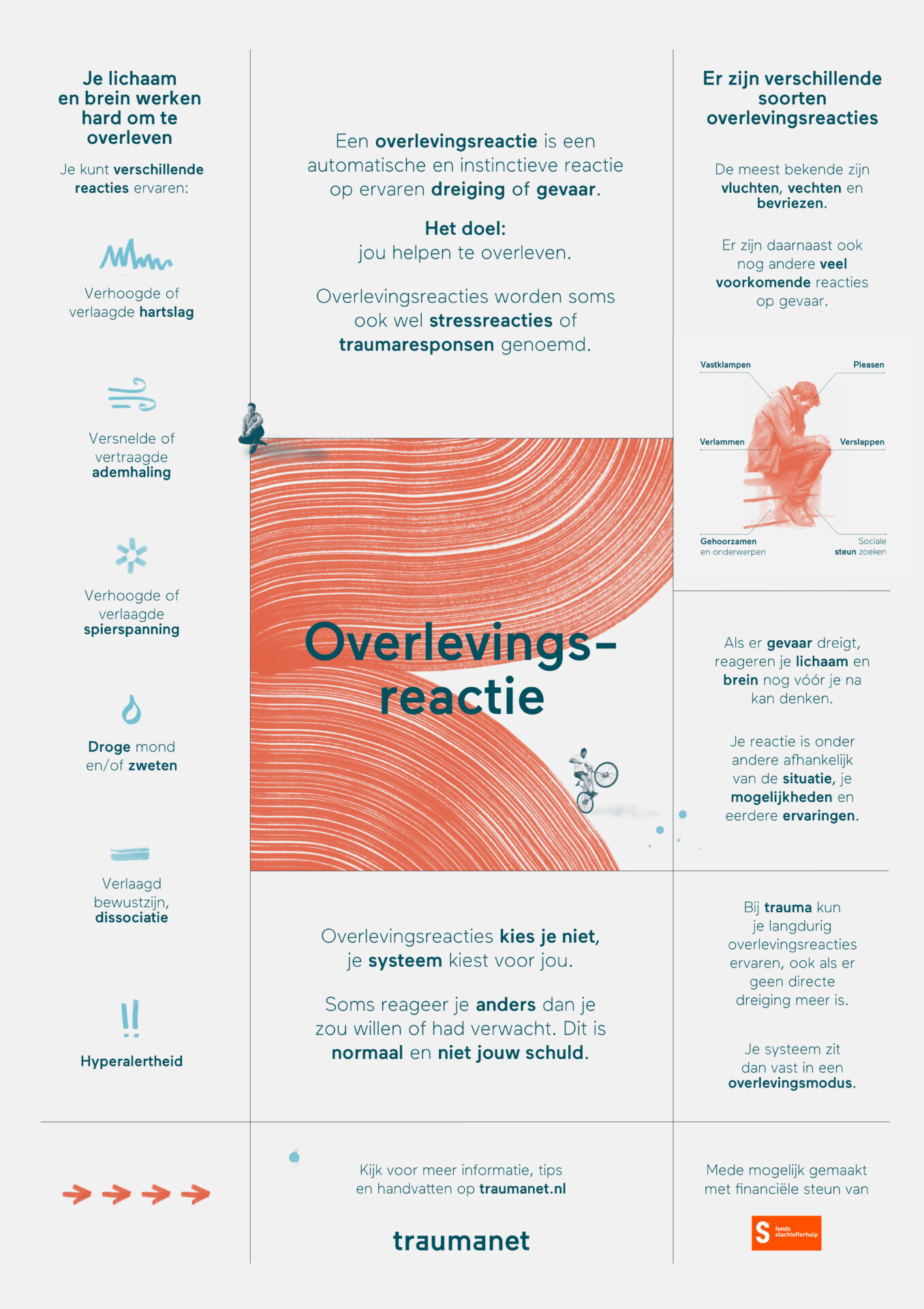
You don't choose survival responses; your system chooses for you
It is impossible to predict how your system responds to a threatening situation. However, it is possible that you naturally lean more toward a certain reaction. For example, some people routinely avoid confrontations, while others speak up immediately. In addition, freezing is a common reaction to a threatening situation from which you cannot escape.
It is also possible that your system has developed a kind of default response, based on past experiences you have had that helped you survive. For example, if you have frozen multiple times in a situation, freezing can become a response that your system quickly switches to, even when the threat in reality is not very large.
It is important to know that you do not consciously choose a survival response yourself; your system chooses for you. With only one goal: survival. So do not blame yourself if you did not do something, or did do something, in a threatening situation. You don't have to reproach yourself for anything, and you have nothing to be ashamed of. It was and is not your fault.
Different survival responses
The most well-known survival responses are flight, fight, and freeze. You can also see these survival responses in animals when they feel threatened.
In addition to fight, flight, and freeze, there are several other survival responses that can be triggered. Common responses include:
- Seeking social connection: call in help, seek contact, cling to someone, make eye contact.
- Flightsmoving away from danger, for example by running away, hiding, or shutting down.
- Fightdefend yourself or someone else, resist, get angry, fight for your life.
- Freezingto be rooted to the spot, to stiffen, unable to move or speak.
- Paralyze and weaken: becoming limp, unable to move. This is a form of freezing where there is not much, but rather very little energy in your system.
- Obeying and mmovenot resisting, but going along with what the other person wants from you, with the goal of making it over as quickly as possible.
- Pleasefawn): keeping on the good side of others, bending over backwards, sweet-talking.
Triggers and survival responses
Survival responses are activated in response to perceived threat or danger. This can involve an actually threatening situation, but also an essentially safe situation in which you are triggered due to something that reminds you (consciously or unconsciously) of a previous threat.
In daily life, you may encounter survival responses in yourself and others at all kinds of moments and in all kinds of forms. Learning to recognize what your survival responses look like and when they are triggered is a first step toward gaining more control over them.