What is IEMT?
IEMT stands for Integral Eye Moment Technique and is a method that can bring relief to persistent complaints. IEMT was developed to neutralize recurring memories and recurring negative emotions, bodily sensations, and beliefs through eye movements.
Through adjustments in the way of looking (literally widening your gaze), fixed patterns can be broken and new connections created in the brain. With this method, light is allowed to shine into the darkest corners of the brain, bringing clarity, healing, and integration.
How did IEMT originate?
IEMT was developed in England by Andrew T. Austin. He wanted to find a solution for clients with multiple traumas. In practice, it turned out to be very difficult for people to (continue to) talk about their traumatic experiences. Treating each trauma separately would require years of therapy.
With IEMT, Austin has created a mix of insights from research, experience, and multiple techniques. The goal is to always get to the core of the problem and bring about positive change in the responses in the client. brain and the body.
How does IEMT work?
The session begins with an introduction exercise with a reminder that is not too stressful for you. Often you get some distance from the reminder and the emotions you feel when you remember it subside. When IEMT is working for you and you feel safe, you and your therapist will go on to explore the beliefs and emotions you experience in everyday life. Reactions in your body The entrance forms the link back to the first time you experienced that feeling. You don’t have to talk about your experiences and memories. As soon as you know what the first time of that feeling was, the eye movements start, while you think about the memory.
IEMT stick
You follow the movements of the IEMT stick in different directions. After a round of eye movements, the residual sensation is examined during recall, in order to further work on the memory traces that are attached to it. Brain associations are followed to arrive at the imprint (the first experience) of this residual sensation. The process continues until all reactions have been neutralized.
New connections
Your memories are reevaluated by the brain. You often experience a greater distance from the old events and healthy boundaries are created between the present and the past. Through new connections, you no longer experience the automatic triggering response reactions. The feeling you experienced at the beginning of the session is no longer automatically triggered. The intensity is less.
What symptoms is IEMT for?
IEMT can be used for both physical, emotional, psychosomatic, and psychological/mental complaints. These may include recurring memories, emotions, bodily sensations, identity experiences, and hindering beliefs, trigger-response reactions, trauma, anxiety, depression, and PTSD.
When can you (better) not do IEMT?
At the time of your registration, a screening takes place to determine whether IEMT can be safely used. The eyes must be healthy and the treatment must be neurologically appropriate. It is also important that there are no psychotic symptoms in the present or in the past. If you have to testify in a criminal trial, permission must first be obtained from the lawyer.
Where can I follow IEMT therapy?
There are quite a few IEMT practitioners in the Netherlands. It is important to carefully assess whether a therapist is a good fit for you and your needs.
Find one here overview of therapists.
Where can I find more information about IEMT?
Reading tips
- Therapeutic picture book ‘IEMT-kids’ – Judith Blaauw
- Integral Eye Movement Therapy: effective in trauma – article in Medical Dossier
- Integral Eye Movement Techniques: The Definitive Guide – Sonya Richards
Watch tip
Online workshops from IEMT developer Andrew T. Austin via YouTube
Reading tip
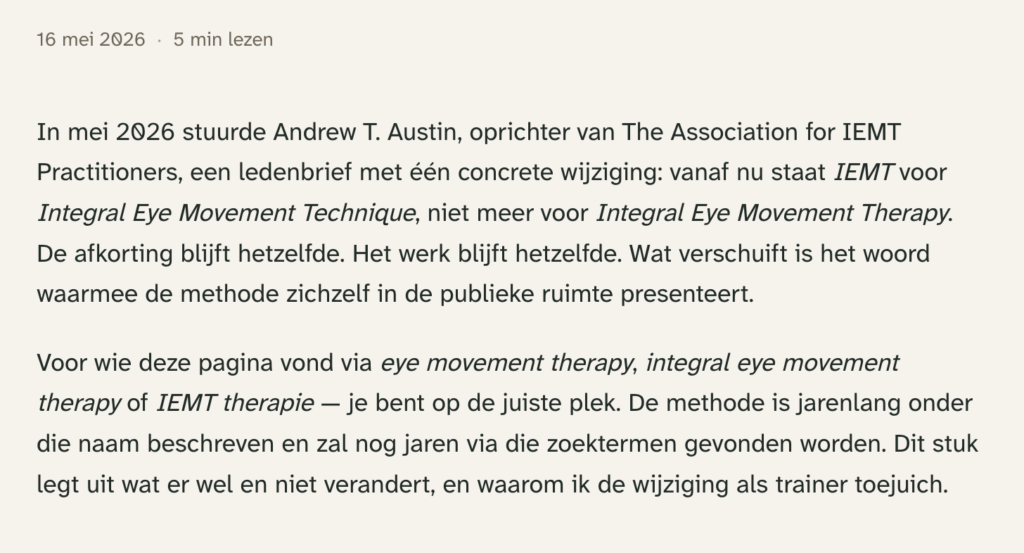
IEMT: Therapy becomes Technique – What is changing?
Article by Mitchel Heitinga
Reading tip
Integral Eye Movement Technique
Article by Meis Thewissen

In collaboration with
Anne ten Brinke, IEMT instructor at IEMT training and Naima Trouk, advanced IEMT practitioner and psychologist.