What is the NeuroAffective Relational Model (NARM)?
NARM stands for NeuroAffective Relational Model and is a therapeutic approach that focuses on the deeper, often unconscious patterns that have arisen from developmental and attachment trauma.
It is a body-oriented, relational, and present-centered approach to working with the wounds that arise when we have not experienced sufficient safety, attunement, or support in our early years of life.
NARM doesn't help by going back to the past or reliving traumas, but rather by exploring what you feel, think, and do in the here and now.
The premise is that every person has a natural movement toward connection, health, and vitality. Trauma can disrupt that movement, but that life energy is not gone; it can be set in motion again. NARM helps you recognize and release old survival patterns, creating more space for connection and self-direction.
How did NARM originate?
NARM was developed by clinical psychologist Dr. Laurence Heller. He worked for years with people struggling with the consequences of trauma and noticed that existing methods often worked well for shock trauma, such as an accident or robbery, but much less for traumas stemming from prolonged insecurity, a lack of attunement, or emotional neglect.
Dr. Heller developed NARM as a way to work specifically with those deeper, more relational wounds. In doing so, he was inspired, among other things, by Somatic Experiencing, psychodynamic therapy and attachment research.
What sets NARM apart is that it is not about re-experiencing or catharsis, but about increasing awareness and resilience in the here and now. Heller calls it a “non-regressive, non-cathartic, resource-oriented” approach. In other words: a way to heal without re-experiencing.
What does a NARM session look like?
A NARM session focuses on restoring connection: with yourself, your body, and others. It is not a therapy in which you dive deep into the past or relive traumas. Instead, you stay mindfully in the here and now, exploring how old patterns still make themselves felt today in your thoughts, feelings, and body.
A session often begins with clarifying your wish or desirewhat would you like to experience or change for yourself? Based on this, the therapist will formulate a with you therapeutic contract, this is a clear intention that guides the process. For example: “I want to explore what is getting in the way of being kinder to myself.”
From that intention, the therapist starts the explorationTogether you examine a recent moment when the pattern you want to understand was visible. What happened? What did you feel in your body? What urge arose, for example, to withdraw, or conversely, to try harder? In this process, there is no judgment or analysis, but rather a curious look at the strategies that once helped to survive.
NARM does not see complaints as mistakes, but as old survival strategies that once offered protection. During the session, it becomes visible step by step how those strategies are still having an effect today, and how you can make different choices in the present.
An important principle within NARM is agency the realization that you have influence over your own inner world. When you become aware of how you maintain old patterns yourself, the possibility to relate to them differently also grows. That marks the transition from a child consciousness, in which you were dependent on your environment, to an adult consciousness in which freedom of choice arises.
During the conversation, the therapist not only follows your words, but also subtle changes in your body: breathing, muscle tension, gaze, tone. These so-called psychobiological shifts show when more connection or relaxation arises. By consciously experiencing those moments, your body learns that safety and closeness are possible.
This is how therapy deepens from insight to embodied experience. NARM works simultaneously ‘top-down’ through awareness and meaning-making, and ‘bottom-up’ through the body and the nervous system. As a result, it helps not only to understand yourself better, but also to feel and react differently.
What complaints is NARM for?
NARM can be used for any issue or complaint resulting from developmental and attachment trauma and fit CPTSD.
NARM can support:
- A constant feeling of emptiness, shame, and self-rejection
- Trouble with trust or closeness
- Boundary issues
- A feeling of being cut off
- Recurring relationship patterns
- Chronic stress or tension
- Physical symptoms without a clear medical cause
- Difficulty with autonomy or self-care
The power of NARM is that it does not try to take away symptoms, but helps to understand why they are there: as old ways of surviving in an environment that was once unsafe. By examining those patterns with gentleness and curiosity, space is created to feel again, to connect, and to live more freely.
Where can I find a NARM therapist?
NARM is offered in the Netherlands and Belgium by therapists trained through the NARM-Training Institute or accredited training partners.
For the time being in the Netherlands, NARM is offered primarily in private practices and mostly by therapists who are (partially) reimbursed through supplemental insurance.
Op bodymindopleidingen.nl You can find an overview of NARM practitioners.
Where can I find more information about NARM?
You can find more background information on the website of NARM Training Institute.
Reading tip
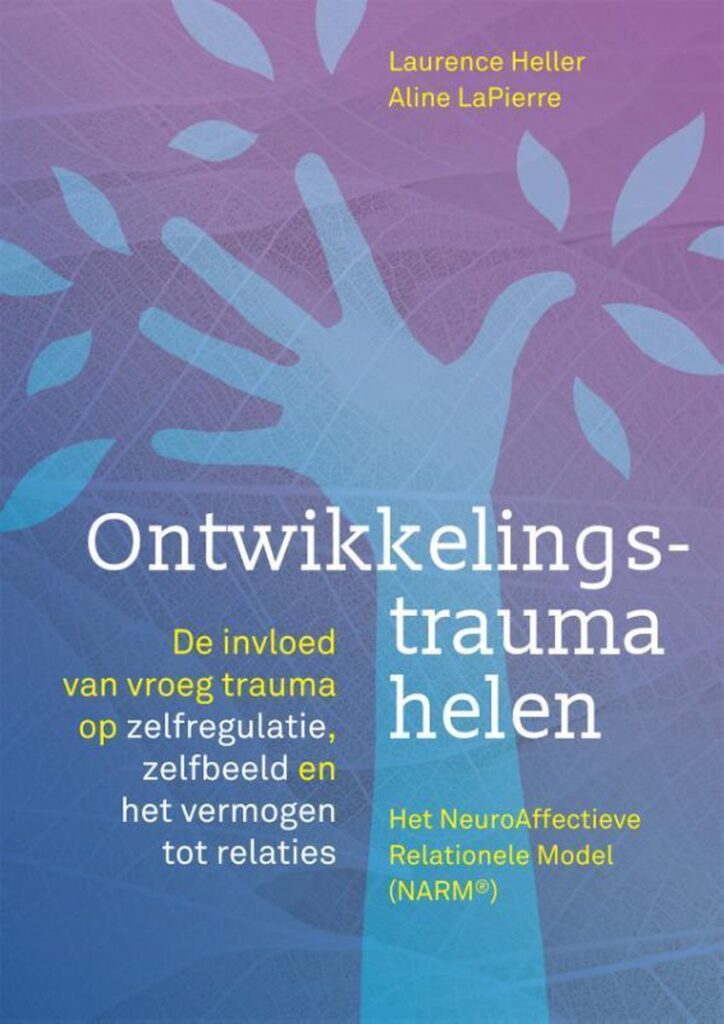
- Healing developmental trauma – Dr. Laurence Heller
Reading tip
Healing developmental trauma
The influence of early trauma on self-regulation, self-image, and the capacity for relationships
Watch tip
What is NARM?
Introducing Laurence Heller