What is dissociation?
Perhaps you recognize it: you suddenly feel absent and disconnected from yourself, as if you are not entirely there. Or the world around you feels strange, as if everything is a bit unreal.
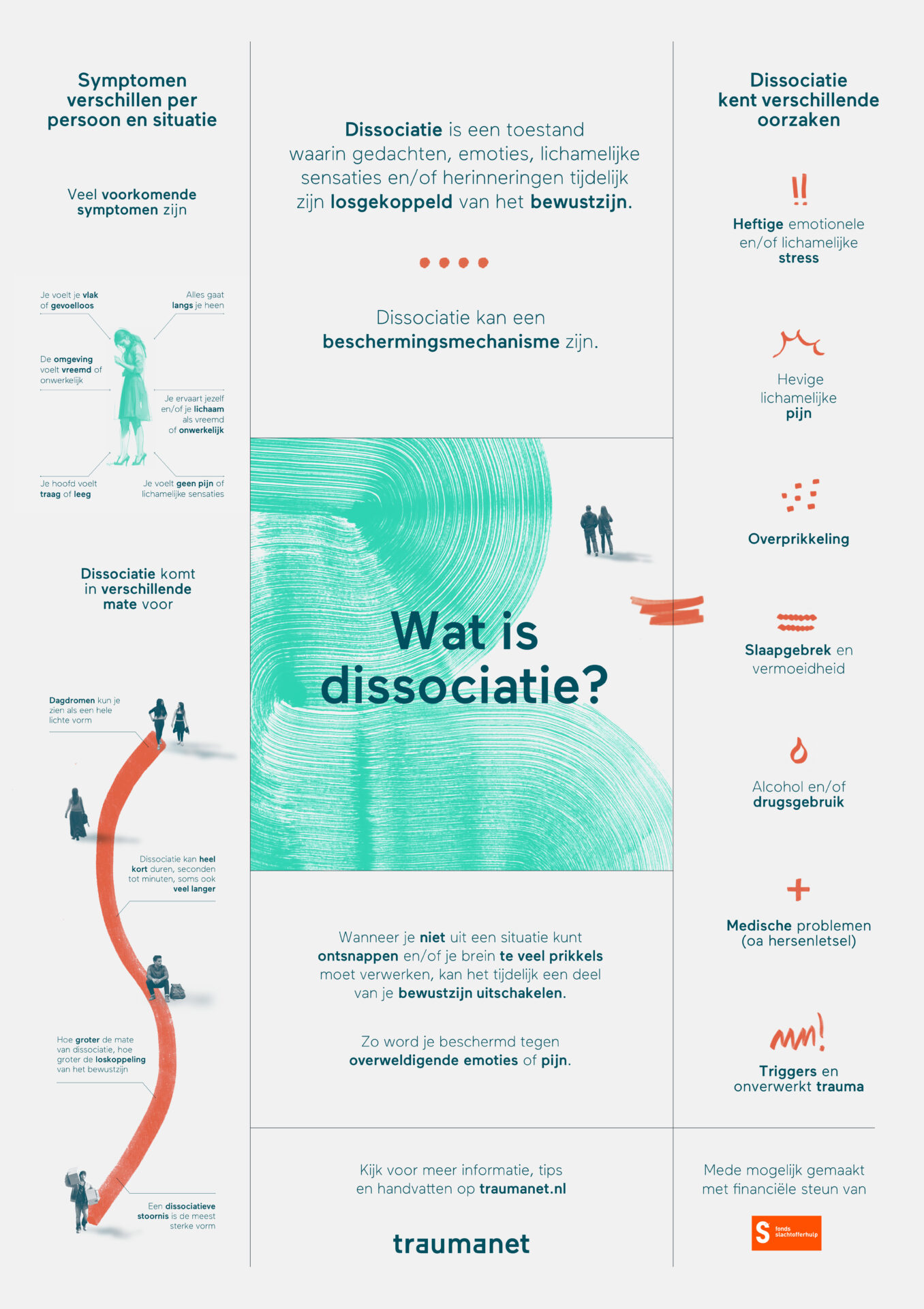
This is called dissociation. It is a way your brain and body cope with stress or overwhelm.
When you are dissociated, things inside you and around you are perceived less consciously or not at all. For example, you might not feel pain, or everything passes you by. It is also possible that you experience things differently than normal, for example distorted, as unreal or fake.
Webinar: 2 november 2026, 19:00 uur
Trauma en dissociatie: hoe je brein je beschermt
In conversation with Tamar van Raalten

Dissociation can manifest in various ways:
- Timeyour perception of time is different than usual.
- Senseswhat you see, feel, hear, smell, taste is disturbed or absent.
- Memoryyou are missing pieces of memory or your memory/memories are vague.
- Emotionsyou feel flat or numb.
- Bodyphysical sensations are disrupted, sometimes you cannot speak or move.
- Environmentthe environment feels strange or unreal.
- Identityyou experience yourself and/or your body as strange or unreal.
These experiences can be confusing and sometimes frightening, but are fundamentally a reaction from your nervous system job stress or overwhelm.
Different degrees of dissociation
Dissociation can have various causes and occurs in both very mild and very severe degrees, and everything in between. It can be an innocent, everyday reaction to fatigue or boredom, but to a greater degree, it can also be a profound consequence of severe trauma. Read more about the causes of dissociation.
Dissociation is therefore on a spectrum, where you can view daydreaming as a very mild degree of dissociation, and a dissociative disorder as the most extreme form at the end of the spectrum.
Daydreaming: a mild form of dissociation
Virtually everyone experiences a mild degree of dissociation at times. For example, when you are daydreaming and not fully present, or when you are driving home on autopilot and suddenly realize you are already home.
You are then not entirely present with your attention and awareness. This mild form of dissociation is very common, and can be caused by fatigue, boredom, or a busy mind, among other things. We often do not use the word dissociation for this mild form, but instead simply talk about daydreaming or having your head somewhere else for a moment.
Dissociation as a defense mechanism
During trauma or extreme stress, dissociation can become a defense mechanism. Dissociation can occur as a reaction to intense emotional and/or physical feelings, and at high levels of stress. In this case, it involves a greater degree of dissociation, where your feelings and thoughts are more disconnected from your consciousness.
At a time of great threat or intense stress, dissociation acts as a kind of defense mechanism of the brain: you temporarily experience less consciously what you feel and what is happening around you. An example of this is feeling no pain when you are severely injured, or feeling no emotions when you have just received intense news.
In such a case, dissociation is a functional mechanism to be able to endure things that are actually too much to bear. Because you are dissociated, you do not experience the impact in its full intensity. In some cases, in a state of dissociation you also completely lose contact with your body for a while, and you cannot move your whole body or a part of it.
The flip side of dissociation
When dissociation happens frequently, it can also become a troublesome and limiting experience. Because although it can be an effective defense mechanism in intense situations, dissociation can become an obstacle when it continues to occur in situations that are not actually threatening or overwhelming, but are still perceived as such by your system.
If you dissociate often and for long periods, it can lead to you becoming (to a greater or lesser extent) cut off from yourself, your feelings, your body, your needs, and/or the people around you. This, in turn, can have all sorts of consequences for your mental and physical health.
For example, you may find it difficult to take good care of yourself. One reason for this can be that it is hard to recognize physical sensations or emotions that would normally be signals to take action, such as eating when you get hungry, or resting when you are tired.
In short, dissociation can be a form of protection, but also a hindrance that has a major impact on your life and health. If this is the case, it can be beneficial to seek professional help and look for ways to cope with dissociation. Read more about trauma therapy and coping with dissociation.
More about this topic