What is your experience with trauma?
‘Loss and abandonment are the common thread. You could say there is a pre-natal and birth trauma. I was born from a hidden pregnancy. Hidden, born alone and immediately given up. In my first year of life, there was a succession of different caregivers. When I was eleven months old, I was adopted. My adoptive parents also brought a thread of love and resilience into my life.
‘I loved my adoptive mother very much, and vice versa. There was an obvious love between us. But a week after I turned fourteen, she suddenly passed away. That was when the journey of problems began. The loss was too great, and there was no one to mourn with. The events followed one after the other like a rollercoaster ride.
‘After my adoptive mother died, I lived with my stepfather, the man with whom my adoptive mother married after the separation of my adoptive parents. He felt very familiar to me. But six months after my adoptive mother died, he suffered a heart attack. He was making chicken soup for me at the time and was stressed. I had just been brought home drunk after drinking a bottle of vieux. My stepfather and his son blamed me for the heart attack. After that, my stepfather kicked me out of the house on my own. That was very confusing. The loss, the separation, and the renewed helplessness.’
What was the impact of all these experiences on you?
‘Addiction. Addiction for support, regulation, calming, and structure. From the very beginning when my adoptive mother was no longer there, I reached for cigarettes and alcohol. The root cause is that I cannot be alone well. My system is still affected by stress. I think that’s very old and goes back to the abandonment I felt as a baby.
‘After being thrown out of my home by my stepfather, I lived with a foster family for two years and then, from the age of sixteen until my nineteenth, in a therapeutic community. Then I moved into apartments. It wasn’t until then that things really got out of hand. From that moment on, I led two lives.’
What did those two lives look like?
‘Looking back, I can see that there were two parts within me. A strong and social part that could venture into the world. The Annemarije who studied journalism, later worked with pleasure at the Humanist Broadcasting, had good friendships, and enjoyed life. And there was the part that carried the burdens. The addicted part, that damaged itself, had an eating disorder and an alcohol addiction. It seemed as if this part functioned independently of me. I could detach myself from it, by being overwhelmed.
‘I have always found the helplessness of addiction the most impactful. You don’t want to reach for the means, yet you still do it. That pull is so strong. Every day I thought to myself: I’m going to get it under control. But then, when I was overwhelmed by sadness and despair and didn’t know how to bear it or stop, I became rudderless.’
What brought about a turnaround?
‘Around the age of twenty-five, I went to a hypnotherapist. There I experienced such a panic attack that I normally would have reached for medication immediately. In that moment, the therapist taught me how to use my breath to calm myself. For the first time, I felt what it was like to make space for my emotions and breathe into them. And then it all fell apart! At that moment, I realized that I had a choice. That I had the power to calm myself and that I didn’t need anyone or anything for that. It was a shift to resilience.
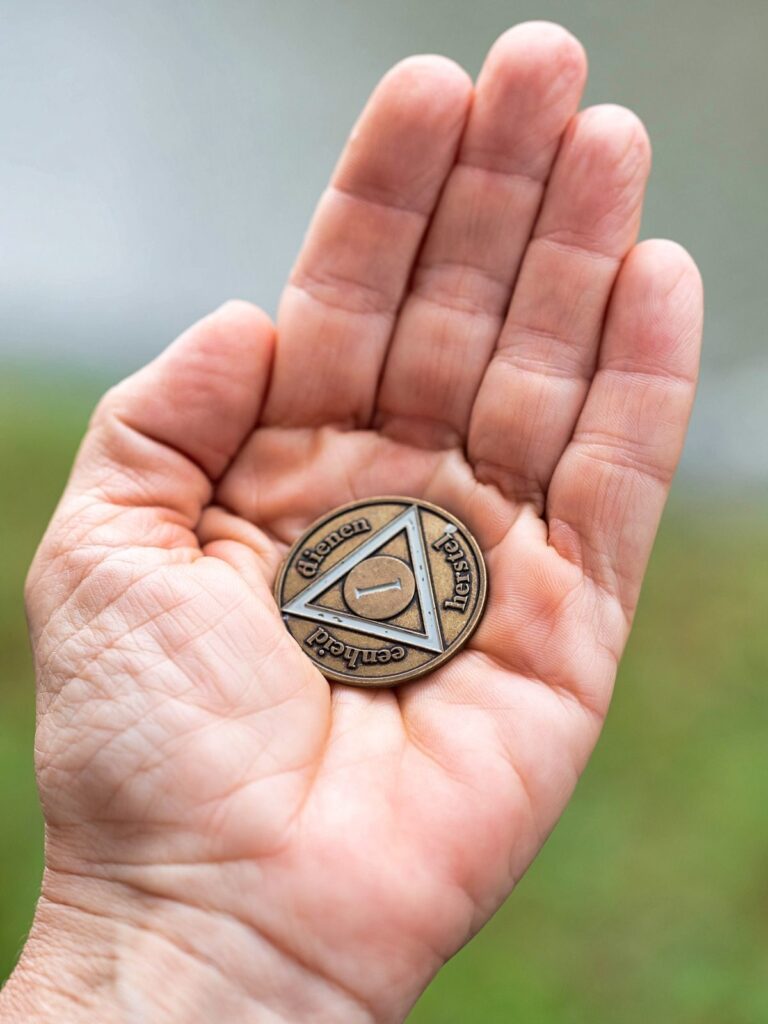
‘Before that, everything was done automatically. With alcohol, but also with food. Episodes of binge eating and vomiting. But from the moment I experienced self-regulation physically, I could also consciously choose what I ate: I had a binge eating episode, but now I’m not vomiting it up. I learned to tolerate and take responsibility. The mindfulness training I followed through the GGZ and the AA meetings also helped me with that. I gained more awareness and no longer did everything that came naturally to me automatically.
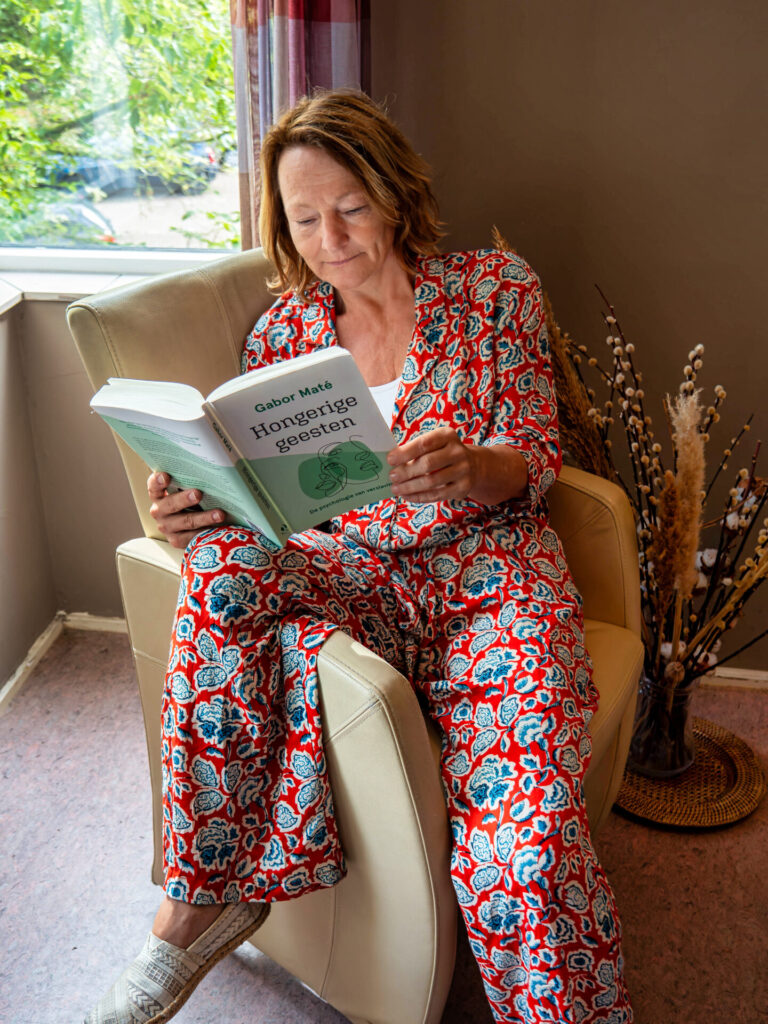
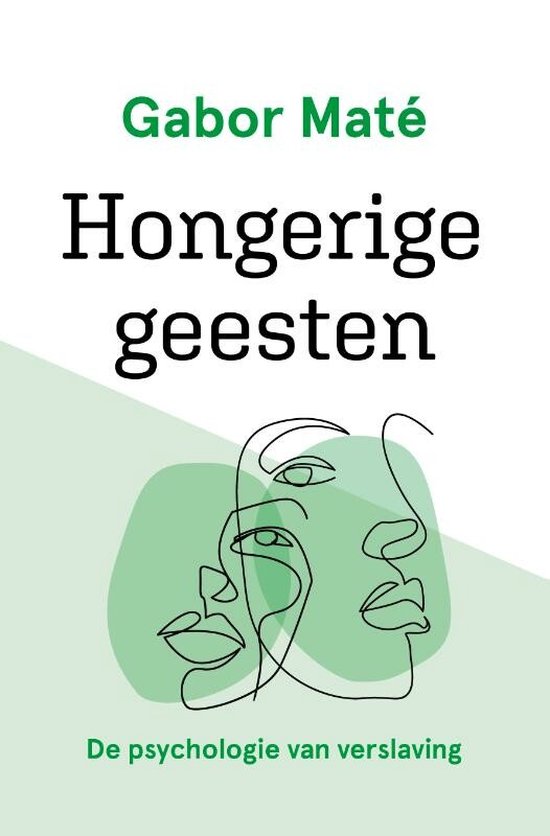
‘Later, books about trauma came my way. Like the inner work of IFS (Internal Family System therapy, ed.) and Hungry Souls by Gabor Maté. That’s when I started to understand how trauma and addiction work. I always thought: I have a disorder, I need to get out of this. The therapists taught me that I could make other choices, but I just couldn’t do it. It was so confusing.
‘Through IFS and the book by Gabor Maté, I was able to develop understanding for myself for the first time. I learned that my addiction was a trauma response, originating from a fragmented part. And instead of always being angry at that part, I went into conversation with it to get to know it. That fragmented child part was so afraid of being rejected and being alone. It needed nurturing and compassion. By caring for this part and for the other parts that worked hard to prevent me from feeling alone, I was able to become more and more sober step by step.’
How did your life change when you became sober?
‘Being sober was really scary at first. As soon as you become sober, everything becomes even more appealing to you. You don’t use it for nothing. It’s really about letting go and you have to learn to regulate yourself in a different way. It felt like I was living naked. On the other hand, my self-confidence grew immediately and I was able to take more space.
‘I also felt guilty. I had been drinking and smoking during my pregnancies. When the children were small, I was a good mother, but I drank every night. I only experienced the consequences of this after I had sobered up. It still bothered me. I still feel the pain from that. But since the children are grown, I can feel more peace about it. This inner work also helps: I am not the guilty one. The guilt is a part, but there is so much more. Especially in recent years, working on this has given me more self-love. More understanding, warmth, and space within myself.’
Were his loved ones important in this process?
‘Yes, it’s vital. I’ve learned to connect from within, but I needed other people for that. Good friends, my adoptive father and his wife who have always supported me, and the closeness of a partner who has been with me for 22 years. In the connection with them, I could relax so much that I was able to connect from within as well.
‘But there are limits to that. Even though I’ve done all these body-focused therapies, when my husband leaves and I’m alone at home, my system still suffers from stress. I have my breath, my cat, meditation, people I can call, thoughts that can reassure me. I have everything at my disposal, but that doesn’t really help deep down. So there’s still not a complete connection between me and that early part of me that shudders when it’s alone.
‘Through years of therapy, I have always been working on improving myself. But lately I am increasingly realizing that it’s about accepting that this is within me. I am entering a new phase and moving from doing to being. From wanting to change myself to actually accepting. Healing is love. Compassion for what is in you, without there having to be anything else. For me, that is a lifelong homecoming.’
3X favorites of Annemarije
Book recommendation
Annemarije: ‘This book excuses people with addiction. Maté explains how the lack of early nurturing leads to a disruption in the serotonin system. This makes it difficult to calm oneself down. Dopamine circuits become overactive. There is hardly any time between impulse and reaction. At the same time, Maté emphasizes the flexibility of brain pathways and explains how you can create more space and more choices with meditation and compassion. You learn to be with yourself, with everything that is.’
Source of inspiration: Peer support – Enik Recovery College
‘The power of peer support, as I experience it daily at my job as a peer support facilitator Enik Recovery College, is and remains a source of inspiration. There is recognition, for both injury and healing, on such a fundamental level. People together create space to (re)learn to connect with themselves and with others. From a sense of shared hope, we shape our own desires. It is so beautiful to be able to rewrite your life story together. My years of work at Enik have brought me so much growth, both as a person and as a professional.’
Charger
‘Playing in the sea, with my good friend Bea! The waves get rougher, the happier we become. In these moments I forget everything around me. I jump into the waves and let myself be carried away, only to jump back in with a mouthful of sand afterwards.