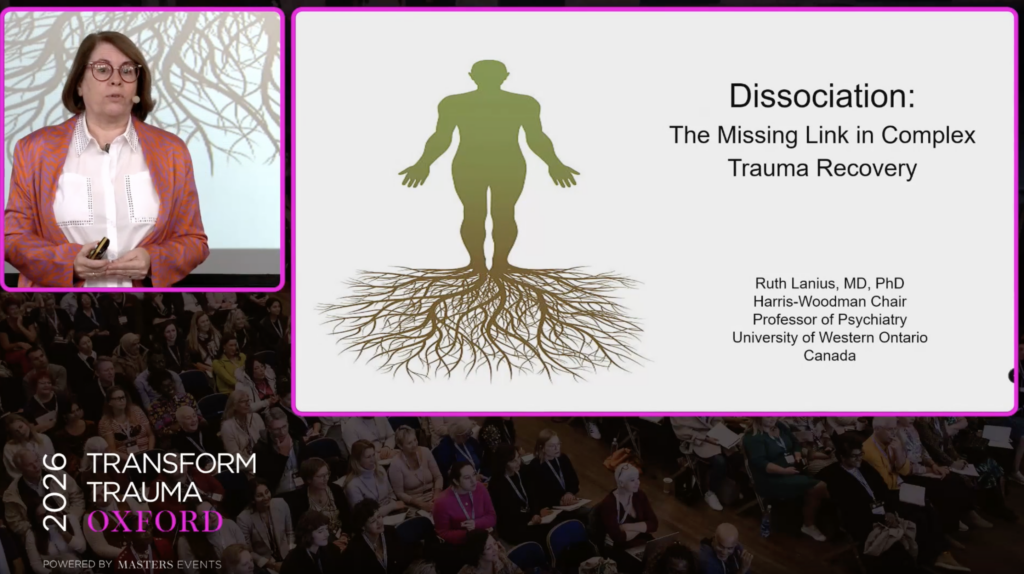
During the Transform Trauma Oxford conference in September, I attended two sessions on dissociation, presented by Ruth Lanius and Mariah Rooney. Both speakers reflected on the complexity of dissociation, the neurobiological processes associated with it, and what this knowledge means for people living with the consequences of trauma. In this article, I share their insights and what I learned from them.
What perhaps touched me the most was the enormous respect with which dissociation was discussed.
Not so much from the perspective of a disorder, a deficiency, or something that needs to be remedied as quickly as possible. But from curiosity about what dissociation has ever made possible. To the intelligence of a survival system that has adapted to circumstances in which escape was not possible.
Dissociation as a brilliant adaptation to the unbearable
Ruth Lanius explained that dissociation can be understood as a psychological escape when physical escape is not possible. When experiences are too overwhelming, the brain can adapt. by somehow disconnecting oneself from what is happening. As if it weren’t really happening. As if you yourself aren’t fully involved in it.
What during traumatic events Protection can provide protection, but it can also come at a high cost. The adaptations that once helped to survive may continue to occur when the original danger has long since passed.
Mariah Rooney went a step further in her description. She spoke of dissociation as ‘a sacred way to survive the unsurvivable’.
An almost sacred way to survive the unbearable.
She described dissociation as a brilliant adaptation to the most terrifying experiences that a human can endure and survive. Not to romanticize the suffering that may be associated with it, but to do justice to what the survival system had to do.
With great respect, she spoke about people who navigate the daily world while their inner world has become extraordinarily complex due to profound experiences.
There can be a tremendous amount going on inside that the outside world has no idea about. And yet these people go to work, have conversations, maintain relationships, and try to shape their daily lives.
How complex that inner world can be is also evident in brain research. Rooney discussed findings that show that in people with a Dissociative identity disorder (DIS) Different identity states can coexist with different patterns of brain activity. Such differences were investigated, among other things, by Reinders and colleagues (2014).
There were also differences found in the activity and cooperation of brain regions those involved in perceiving signals from their own body, such as hunger, pain, or tension. But also in the feeling that your body is yours, that you are yourself, and that your own thoughts and actions also truly feel like yours.
It’s about something that we usually take for granted: the feeling that you are yourself, in your own body. This is also called embodied self-awareness called, or embodied self-awareness.
With dissociation, these experiences can be disrupted. What seems obvious to many people may then not be so obvious at all.
Reading tip
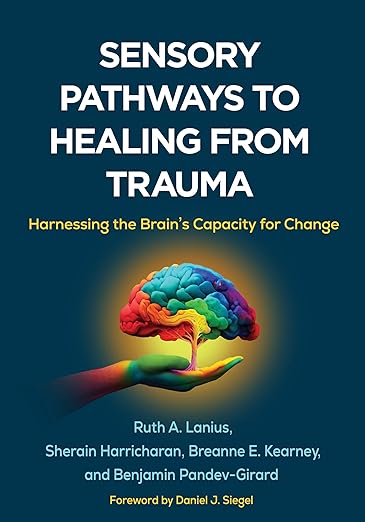
Sensory Pathways to Healing from Trauma
Harnessing the Brain’s Capacity for Change
The invisible price of survival
But what does it really mean when the contact with your own body changes? When your body emits signals that you can no longer perceive properly, or when you even lose the sense that your body is yours?
Rooney addressed a common misconception about dissociation. Often it is thought that someone who dissociates ends up in a state of reduced physical activity. As if the body and the nervous system as if they were turned off.
But it doesn't seem to be that simple.
Rooney discussed research findings that do not provide a clear picture: dissociation does not always go hand in hand with lower physical activity. For example, someone may feel numb, absent, or completely shut down, while the body is still highly activated.
The processing of signals between the body and the brain can also be disrupted. The body still sends out signals, but they are not always perceived or experienced in the same way. Think for example of tension in your muscles or an accelerated heart rate, without you being able to feel that tension yourself.
Dissociation and body perception
Feeling not tense does not necessarily mean that your body is relaxed. The physical state, the conscious experience of it, and the visible behavior do not necessarily have to correspond to one another. This makes it difficult to draw conclusions based on what someone says or shows.
Ruth Lanius described how profoundly that disruption of body perception can be. People may feel that their body is no longer their own. In severe cases, even the ability to recognize the limits of their own body can be impaired.
It’s like your body starts and ends at a point you can’t feel anymore. It’s as if the boundary between yourself and the outside world fades away. Or as if your body is no longer yours at all. This can be an extraordinarily frightening experience. Lanius spoke about a ‘intolerable feeling’: an almost unbearable feeling.
Sometimes people can only begin to feel their bodies again when they experience very strong physical stimuli. Lanius explained that this can contribute to self-harm, but also to the desire to be held tightly or physically restricted.
What may be difficult to understand from the outside, can be a desperate attempt from within to feel one’s own body again. To experience where one’s body begins and ends. This is one possible explanation for such behavior, not an explanation for all forms of self-harm.
Disrupted cooperation between the body and the brain
But the consequences of dissociation are not limited to what someone can or cannot feel. Normally, our brain continuously processes information from our body. That information helps us orient ourselves, react, and act without having to consciously think about every movement or reaction.
In dissociation, this cooperation can be disrupted. Lanius described how someone can become more dependent on conscious thinking to understand what is happening and how to respond to it.
What happens largely automatically for others can require a lot of thought. That takes an enormous amount of energy. And maybe that is one of the most underestimated aspects of dissociation: how much effort can be hidden behind someone who appears to function normally on the outside.
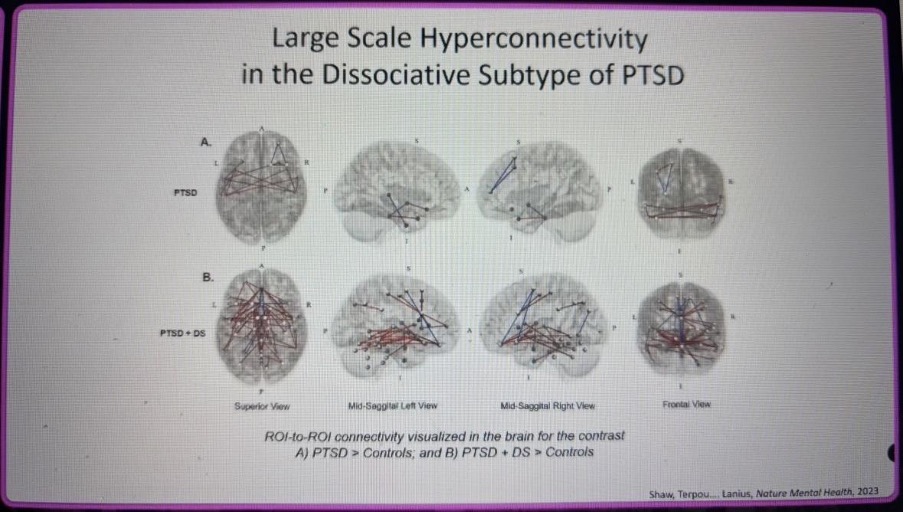
In addition, Lanius demonstrated research on the cooperation between different brain regions. She referred to research by Shaw and colleagues (2023), in which people with the dissociative subtype of schizophrenia showed increased connectivity between the left and right hemispheres. PTSD A striking pattern of stronger coherence in brain activity was found compared to healthy controls.
That might sound contradictory. After all, when we think of dissociation, we immediately associate it with the breaking down of connections. But the brain appears to work in a more complex way. While certain forms of processing can become impaired, other brain regions can actually work more closely together.
The image below shows that.
Reading tip
Finding Solid Ground - Workbook
Overcoming Obstacles in Trauma Recovery

What we don't see, we also can't understand on our own.
Precisely because dissociation can occur largely within the mind, it is not necessarily the case that the environment or even the help provided recognizes what is happening. Lanius referred to recent research by Fung and colleagues (2026). In two studied groups, 71.7 to 84.2 percent of participants with suspected complex PTSD also exhibited dissociative symptoms.
Dissociation is therefore anything but exceptional in people with complex trauma complaints. Yet it is not always recognized. Lanius spoke of dissociation that ‘hidden in plain sight’ remains: hidden in plain sight.
Someone can have a conversation, give responses, function, and even express what is happening in a particularly good way, without it being clear how that person really feels on the inside.
What's more, Dissociative experiences This can be accompanied by a lot of shame. How do you tell someone that you sometimes can’t feel good about your own body? That you feel disconnected from yourself? That you sometimes can’t explain what’s going on inside you? And how do you know if the other person understands what you’re trying to tell them?
This requires not only knowledge of dissociation from therapists, but also the willingness to ask about it actively, carefully, and without assumptions. Because when dissociation is not recognized, it can also have consequences for the treatment.
Too complex to treat?
Rooney told how people with severe dissociative symptoms sometimes hear that they are ’too much’ of ’too complex’ It's too much, too complicated to handle.
While they often have already come a long way behind them. With various diagnoses that do not adequately reflect their experiences, Medications that do not always prove appropriate and treatments that may not sufficiently take into account dissociation.
When a treatment does not have the expected effect, the explanation does not necessarily lie with the client. What appealed to me was that during the sessions, space was created for other questions.
Is there perhaps a mismatch between the client and the treatment? Do we fully understand what is happening in the inner world of this person? As professionals, have we not learned enough about dissociation? And are we really alert enough in the treatment room to the signs of it?
These are questions that shift the perspective from the client who does not sufficiently benefit from treatment to the joint search for what is still not seen or understood.
Learning from people with dissociative experiences
What I take away from Oxford is not only new knowledge about dissociation. It is especially the way that knowledge was approached. With respect for what was once necessary. With an acknowledgement of the suffering that can arise in the present. And with curiosity about what we as professionals still do not understand.
Rooney said that as a trauma therapist she has learned a tremendous amount from people with complex dissociative experiences. Not only about dissociation itself, but also about the impressive ways in which people can adapt to unimaginable circumstances.
Perhaps that is what stayed with me the most during both sessions: the willingness to not only look at dissociation from a professional perspective, but also to learn from the people who live with it.
Dissociation does not need to be romanticized in order to recognize its original protective function. And that recognition does not mean that we should underestimate the limitations and suffering in the here and now.
Perhaps better understanding begins with the realization that behavior, functioning, and even the ability to articulate experiences never tell us the full story. That what we see on the outside does not necessarily show how much someone has to bear within. And that curiosity about what we don’t know yet is not a sign of insufficient expertise but an essential part of it.
Janet writes for the Traumanet editorial team from her professional background as an NGO-orthopediatrician and as an experienced expert. In September 2026 she also attended the congress Transform Trauma Oxford, In her work and writing, she combines scientific knowledge, professional practice, and lived experience. She is also interested in asking questions about what we think we see, know, and measure, with particular attention to what is easily overlooked.
Scientific sources
Fung, H. W., et al. (2026). The relationship between complex PTSD and dissociation: longitudinal findings across Western and South Asian female samples. Social Psychiatry and Psychiatric Epidemiology, 61, 1259–1269. https://doi.org/10.1007/s00127-026-03053-z
Reinders, A. A. T., et al. (2014). Opposite brain emotion-regulation patterns in identity states of dissociative identity disorder: A PET study and neurobiological model. Psychiatry Research: Neuroimaging, 223(3), 236–243. https://doi.org/10.1016/j.pscychresns.2014.05.005
Shaw, S. B., et al. (2023). Large-scale functional hyperconnectivity patterns in trauma-related dissociation: An rs-fMRI study of PTSD and its dissociative subtype. Nature Mental Health, 1, 711–721. https://doi.org/10.1038/s44220-023-00115-y