What is the Window of Tolerance?
Everyone faces stressful moments in their life. You can react to this in different ways. Sometimes you become irritable, angry, or panicked. At other times, you might feel numb or withdraw.
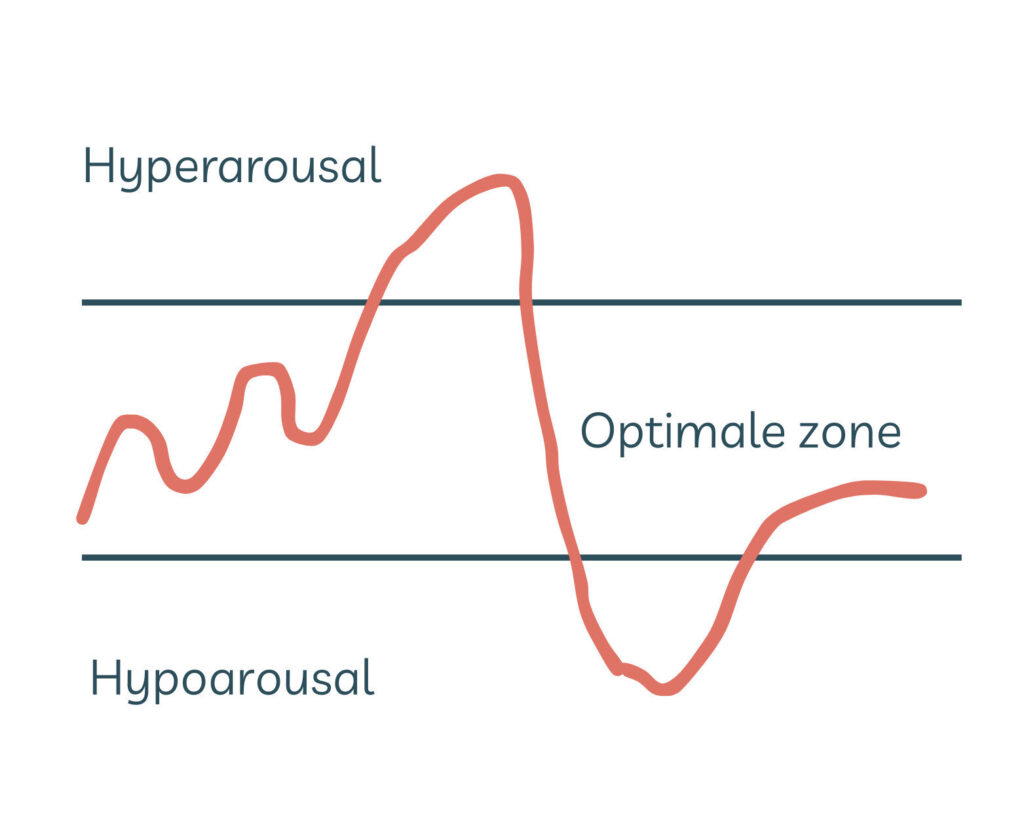
In 1999, American psychiatrist Dan Siegel described the theory of the Window of Tolerance. This is the zone where you can tolerate tension and emotions well and are in balance.
Various words are used for this concept, such as: window of tolerance, window of resilience, stress window, or, very simply, your window or a small window.
Animation about stress and the Window of Tolerance
Augeo Foundation developed together with Dutch Foundation for Children's Stamps an animation about the window of tolerance. This explains in an accessible way what the window of tolerance is and the influence of stress.
Within your window: in balance
Within your window you feel balanced and calm. This is also called the optimal zone named. You are connected to yourself and to the other. Your mind is clear: you can think well, make choices, and maintain an overview. You can also experience your emotions without becoming overwhelmed. Within your window, you respond from a place of calm, rather than from survival. As a result, you are able to respond appropriately to situations.
Everyone experiences changes in tension and emotions throughout the day, that is a normal part of life. Even when you are well-balanced, your tension and energy fluctuate. Resilience means that you are able to cope well with that tension or pressure and do not fall outside your window.
Outside your window: flooded
There are several things that can cause you to get outside of your window. Sometimes they also occur simultaneously, and reinforce each other. Examples of this are:
- Lack of rest or sleep: taking insufficient time to relax, too little sleep.
- Too much stress or pressuresuch as deadlines at work, financial worries or conflicts.
- Intense emotionsfor example, sadness after bad news, fear of a presentation, or anger in an argument.
- Triggers, trauma memories: a scent, sound, or situation that triggers old pain or fear.
- Overstimulationbusy places, (too) many social contacts in one day, loud noises or bright light.
- Physical workloadpain, illness, fatigue, or hormonal changes.
- Too little stimulationloneliness, prolonged boredom, or lack of challenge.
Hyperarousal and hypoarousal
When you get outside of your Window of Tolerance, your autonomic nervous system it takes over from you. That happens automatically and very quickly. Your body then reacts from old survival responses:
- In hyperarousal will it be sympathetic nervous system Activated. This is the part that prepares you to fight or flee. Your energy skyrockets.
- In hypoarousal takes it parasympathetic nervous system the upper hand. Your energy drains away. This is a freeze or collapse response, meant to protect you when fight or flight is not possible.
Characteristics of hyperarousal
You can notice hyperarousal as follows:
In your behavior:
- You react irritably or get angry faster
- You talk busily or loudly or scream faster
- You are moving restlessly; cannot sit still, are pacing, are fidgeting
- You are quicker to get defensive
In your body:
- You are hypervigilant, jumpy, and constantly looking around you
- Your heart rate is elevated, your heart is pounding in your chest
- Your breathing is fast and ragged
- Your muscles are tense (shoulders, jaws, fists), you are constantly ‘on’
- Others may notice that you have large pupils
In your thoughts and feelings:
- You experience panic, anxiety, or anger
- Your thoughts keep racing, you are worrying or thinking in doomsday scenarios
- You are having trouble thinking clearly, seeing the big picture, or making choices
- You feel completely overwhelmed
Characteristics of hypoarousal
You can notice hypoarousal in the following way:
In your behavior:
- You withdraw or go quiet
- You have little to no energy to do anything
- You hardly respond to anyone, you seem unreachable
- You come across as distant, detached, or absent
In your body:
- Your breathing is slow and shallow
- You have a low heart rate
- Your muscles are limp, you move very little, sometimes you cannot move (a part of) your body at all (this is also called somatoform dissociation named
- You may feel heavy or numb
- You feel very tired or exhausted
In your thoughts and feelings:
- You are suffering from concentration problems
- You are having trouble finding the right words
- You feel absent or feel like you are not really there
- You feel empty or flat, or experience no emotions at all
- You feel like everything is too much, you have to do all sorts of things, and you would rather just disappear
Nervous systems can develop preferred responses; one tends more quickly toward hypoarousal and the other toward hyperarousal. It is important to know that these responses during traumatic experiences and in the here and now are not ‘wrong’ or ‘weak.’ They once originated to help you survive. The tricky part is that your body sometimes still reacts like that even now, even though you are often safe in the here and now.
The Window of Tolerance and trauma
When you have experienced something profound, it can disrupt your nervous system for a long time. Because of trauma, your Window of Tolerance often becomes smaller. This means that the ‘optimal zone’ in which you feel calm and tranquil is narrower, and you become dysregulated more quickly. Sometimes you shoot into hyperarousal and sometimes into hypoarousal. These can also alternate more rapidly.
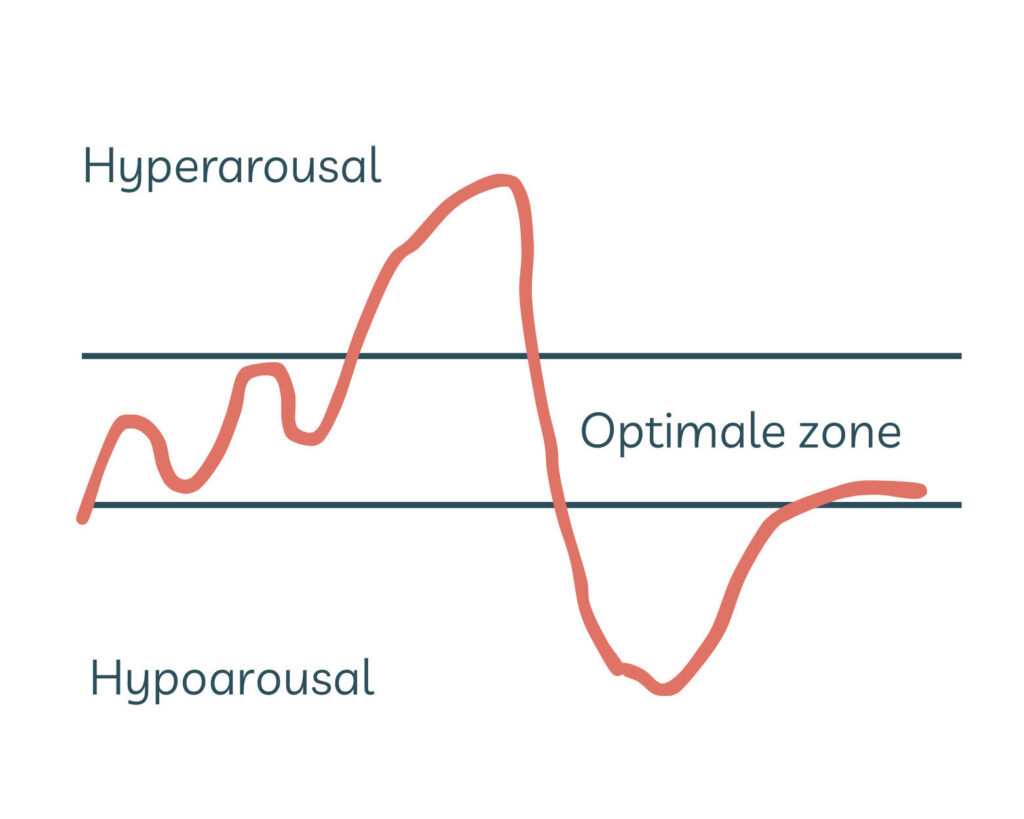
Additionally, with a narrower window, it can take longer to return to a state of calm and clarity. In daily life, this can mean that you are less able to concentrate, get into conflict more quickly (with yourself or with others), or withdraw from contact more often. These are old survival reactionsyour body does this to protect you.
Reading tip
A workbook for traumatized people and therapists

Broadening your window
You can widen your window of tolerance step by step. That starts with awareness and experiencing small moments of rest and safety. By learning to recognize what helps you calm down, your nervous system can slowly gain more capacity to tolerate tension.
On Traumanet you can find various resources that can support you in this. Also take a look at the article Dealing with dysregulation en Daily habits that build resilience where you will find practical tools to calm yourself down again when you get out of balance.

More about this topic