Treatment for C-PTSD differs
Because people with complex PTSD, in addition to ’traditional’ PTSD symptoms also have problems with, among other things, self-regulation, (self-)confidence and dissociative symptoms, standard PTSD treatment is often insufficient or ineffective.
There is no single specific treatment for complex PTSD; in many cases, different forms of treatment are combined. In addition, just like with PTSD, even with complex PTSD, it depends per person on what someone suffers from the most and what someone needs.
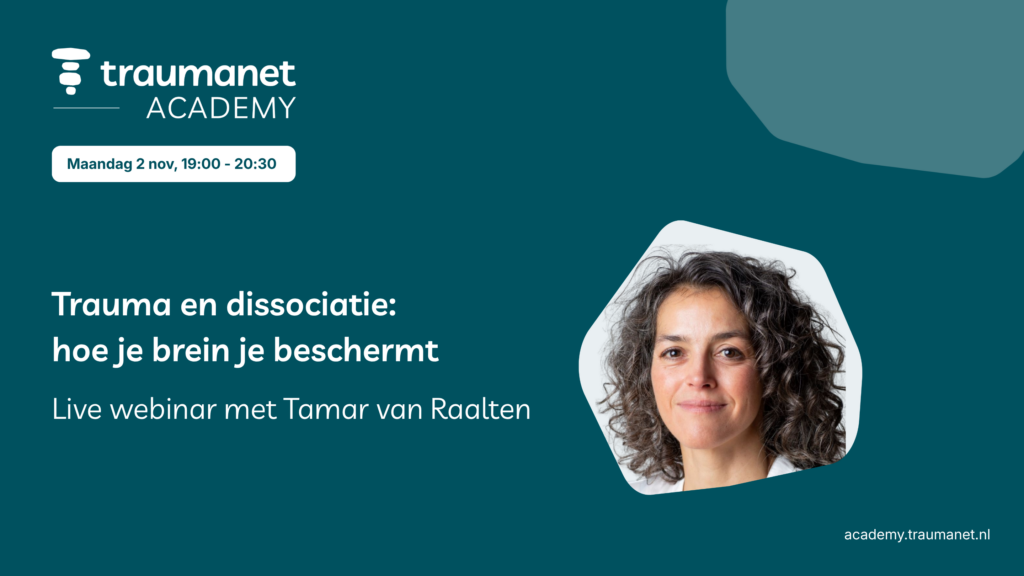
Webinar: 2 november 2026, 19:00 uur
Trauma en dissociatie: hoe je brein je beschermt
In conversation with Tamar van Raalten

Phase-oriented treatment
In the treatment of complex PTSD, a phase-oriented treatment model consisting of three phases is often used. The various phases are not always fully completed and can also alternate with one another. This depends on the symptoms a person experiences, their capabilities, and previous treatment experience.
Various forms of treatment can be used in all phases of treatment. Which ones these are varies per person.
Phase 1: stabilization, symptom reduction and safety
Phase 1 focuses on stabilization, symptom reduction, and building safety. This can involve external safety, such as a safe place to live, but also internal safety, such as learning to take good (enough) care of yourself.
During phase 1, various components can be covered, including: explanation of trauma and complaints (psycho-education), increasing insight into complaints, enhancing emotion and tension regulation skills (coping with dysregulation), improving self-care, and mapping out the social network and how to utilize it.
The first phase focuses primarily on the here and now.
Phase 2: trauma processing
The second phase is also called the trauma processing phase. In this phase, memories of traumatic experiences take center stage and work is done on symptoms directly related to these, such as flashbacks and avoidance.
In this phase, various treatment methods can be used, including: EMDR, exposure therapy, imagery rescripting, Narrative Exposure Therapy (NET), Sensorimotor Psychotherapy and various forms of occupational therapy.
In the second phase, ‘the past’ is central; work is done with the past.
Phase 3: Integration
The third phase focuses on integrating what has been learned in earlier phases into daily life. In this phase, attention to themes such as grief, the restoration of sexuality and intimacy, parenting, and a sense of purpose can be important.
In the third phase, the past, the present, and the future take center stage.
Justice – an under-examined phase of recovery
Psychiatrist and professor Judith Herman described three phases of recovery in her book Trauma and recovery. In her newest book Truth, restoration of honor, and justice, she adds a fourth step: the step of justice. This step has received little attention so far, she noted.
Her work shows that people with trauma do not only want to process their own story. They also want society to recognize and support them. Victims desire that bystanders do not look away. Yet that often happens. Some victims share that others looking away hurt them more than the event itself.
The fourth step, justice, therefore goes beyond personal recovery. It also touches upon society and politics. It is a process in which everyone has a role. More and more people and groups are now paying attention to this.
Book recommendation
Truth, restoration of honor and justice - Judith Herman
An underexposed phase in the process of trauma healing

Types of trauma therapy for complex PTSD
The treatment of complex PTSD often consists of various forms of trauma therapy. In addition to the modalities that can be used in phase 2 for trauma processing, there are also a number of specific treatment methods that are frequently used for complex PTSD:
- Trauma-Focused Mentalization-Based Treatment (MBT-TF)
- Schema therapy
- Dialectical Behavior Therapy (DBT)
- NeuroAffective Relational Model (NARM)
- Sensorimotor Psychotherapy
In addition to these treatment methods, other forms can also be effective and valuable. What works for whom ultimately varies per person.
More about complex PTSD